
📘 Data Structures – Course Description
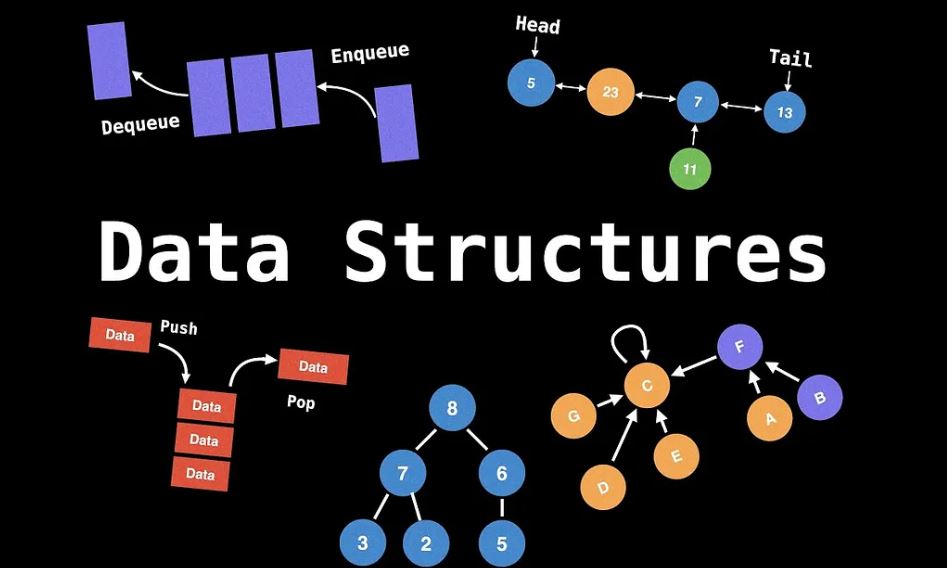
Data Structures form the backbone of computer science and programming. They define the way data is organized, stored, and retrieved efficiently to solve complex problems. This course gives you a strong foundation in arrays, linked lists, stacks, queues, trees, graphs, and hash tables, along with their real-world applications.
Through hands-on coding in C/C++/Python, you’ll learn how to design efficient algorithms, analyze performance (time and space complexity), and implement solutions that power everything from operating systems to artificial intelligence.
By mastering Data Structures, you build the essential skills needed for competitive programming, software development, and technical interviews at top tech companies.
📌 What are Data Structures?
Data Structures are specialized formats for organizing, storing, and managing data so it can be used efficiently. They define not only how data is stored but also how operations like insertion, deletion, searching, and sorting are performed.
Efficient use of data structures improves the performance of algorithms, reduces memory usage, and makes complex software systems manageable.
📚 Types of Data Structures
- Primitive Data Structures
- Basic data types like
int,float,char,boolean. - Foundation for building non-primitive structures.
- Basic data types like
- Non-Primitive Data Structures
- Linear Data Structures (elements arranged sequentially)
- Arrays → Fixed-size, fast access using index.
- Linked Lists → Dynamic size, easy insertion/deletion.
- Stacks → LIFO (Last In, First Out) structure.
- Queues → FIFO (First In, First Out) structure, includes variations like circular queue, priority queue, deque.
- Non-Linear Data Structures (hierarchical or interconnected arrangement)
- Trees → Hierarchical structure (Binary Tree, BST, AVL, B-Tree, Heap, Trie).
- Graphs → Set of nodes and edges representing relationships (Directed, Undirected, Weighted).
- Hash-based Structures
- Hash Tables / Hash Maps → Store key-value pairs for fast access.
- Linear Data Structures (elements arranged sequentially)
⚙️ Operations on Data Structures
- Traversal → Access each data element.
- Insertion → Add new elements.
- Deletion → Remove elements.
- Searching → Find an element.
- Sorting → Arrange elements in order.
- Updating → Modify existing elements.
🚀 Applications of Data Structures
- Arrays → Database indexing, image processing.
- Linked Lists → Dynamic memory allocation, music playlists.
- Stacks → Expression evaluation, undo/redo in editors.
- Queues → Scheduling (CPU, printers, networking).
- Trees → File systems, hierarchical databases, compilers.
- Graphs → Social networks, routing algorithms, web page ranking.
- Hash Tables → Caching, symbol tables, password verification.
🎯 Importance of Learning DS
- Forms the backbone of algorithms and problem-solving.
- Improves code efficiency and system performance.
- Essential for competitive programming, interviews, and real-world projects.
- Builds strong foundations for advanced topics like Databases, Operating Systems, AI, and Networking.
🌟 Why Choose a Data Structures (DS) Course?
1. Foundation of Computer Science
- Data Structures are the core concepts behind almost every software system.
- They provide the building blocks for programming languages, operating systems, databases, compilers, and networks.
- Without DS knowledge, solving real-world problems becomes inefficient.
2. Improves Problem-Solving Skills
- A DS course teaches how to approach problems logically.
- You learn which data structure fits best for a given problem—arrays, trees, graphs, or hash maps.
- This structured approach makes you a stronger programmer and thinker.
3. Essential for Coding Interviews & Competitive Programming
- Almost all top tech companies (Google, Microsoft, Amazon, Infosys, TCS, etc.) test candidates on DS and Algorithms.
- A DS course prepares you with the right problem sets, coding practice, and confidence for technical interviews.
- Competitive programming heavily depends on DS for time and memory optimization.
4. Boosts Software Development Skills
- Real-world applications—from web apps to AI systems—rely on efficient DS usage.
- Example:
- Social media platforms use graphs for friend suggestions.
- Search engines use trees and hash tables for fast lookups.
- OS schedulers use queues and heaps for process management.
- Learning DS makes you industry-ready.
5. Enhances Logical Thinking & Optimization
- DS courses train you to think about time complexity (speed) and space complexity (memory).
- Helps write code that is scalable, maintainable, and efficient.
- Makes you stand out as a developer who writes smart solutions, not just working solutions.
6. Career Growth & Opportunities
- Strong DS knowledge is a must-have skill for roles like:
- Software Developer / Engineer
- Data Scientist
- Competitive Programmer
- System Architect
- Database Engineer
- DS is also the stepping stone for advanced fields like Machine Learning, Blockchain, and Cloud Computing.
7. Long-Term Value
- Programming languages change, but Data Structures remain constant.
- Once you master DS, you can apply the knowledge across any language (C, C++, Java, Python, Go, etc.).
- It’s a lifetime skill that keeps you relevant in the ever-changing tech world.